On Bergen Assembly’s A Machine as Complex as the World Itself
Commissioned contribution by Punch Viratmalee
A Machine as Complex as the World Itself
A first gathering towards Bergen Assembly 2028
September 11-12, 2026
Korskirken, Bergen
In her speech introducing the event, “ A Machine as Complex as the World Itself,” curator Lucia Pietroiusti made a gesture to address the inherent paradoxical nature of the event’s title, a curious phrase that seems to intentionally create confusion and open up towards more inquiry and possibilities. In my case, it provoked a slight suspicion; that is the “vibe” I got from attending the one-and-a-half-day gathering under this rather mouthful title. A gathering that serves as a starting point in the process leading to the 2028 iteration of the triennial, based in the rainy town on Norway's west coast.
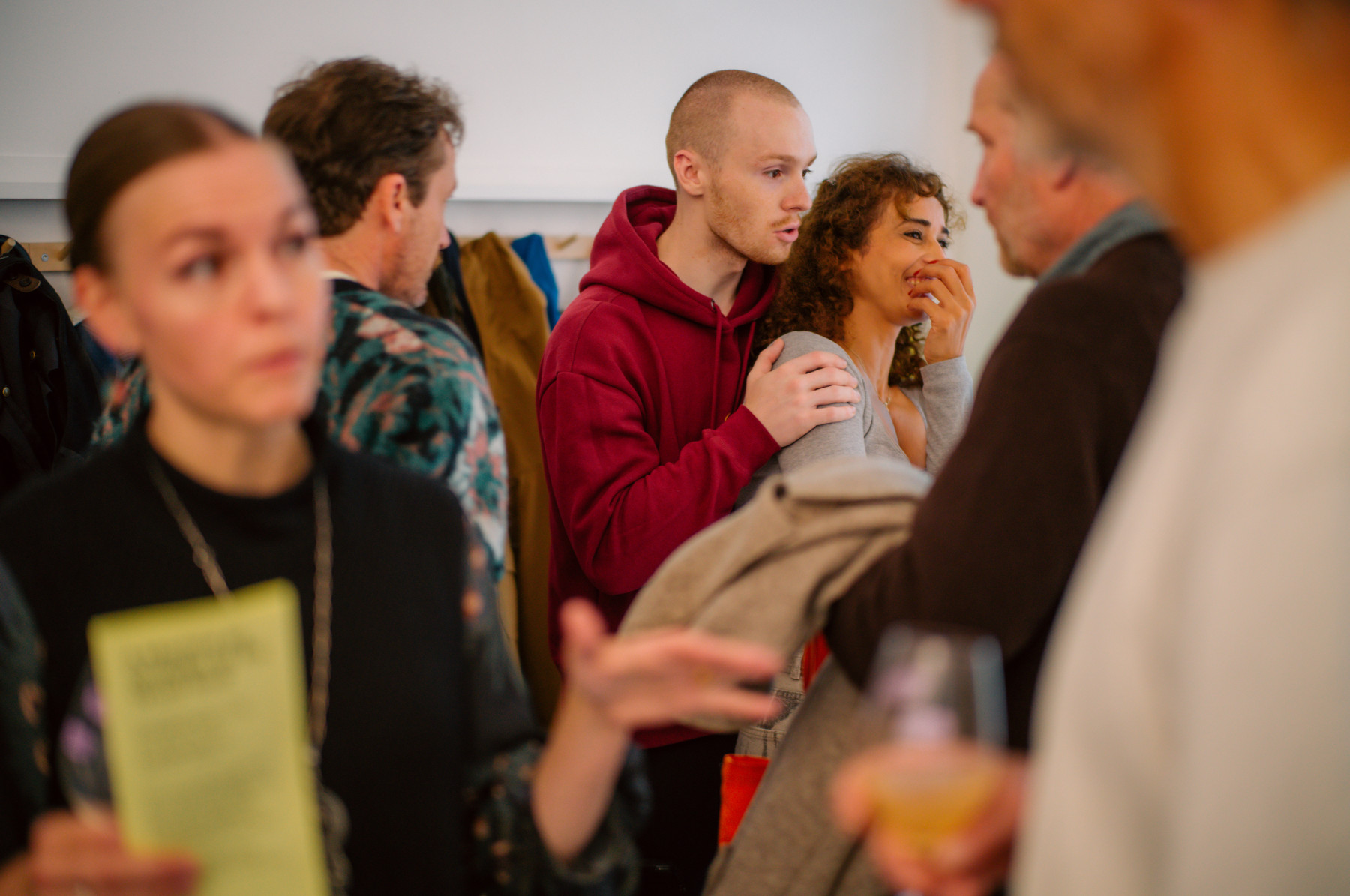
Welcoming drinks at the Bergen Assembly office, photo credit : Stian Servoss
I arrived in Bergen slightly exhausted from a few days in Berlin, where the frenzied hedonism of Berlin Art Week is in full swing. The last thing I saw before leaving Berlin was the Maurizio Cattelan show at the Neue Nationalgalerie, a show which I jokingly told my friend is for people who actually hate art, and filled me with such dread that if someone like Mr Cattelan should get such recognition as an exemplary artist, maybe it is ok after all for mankind to become extinct. But he is not my focus today, and I shouldn’t dwell for too long there, but that did set the tone for the rest of my trip.
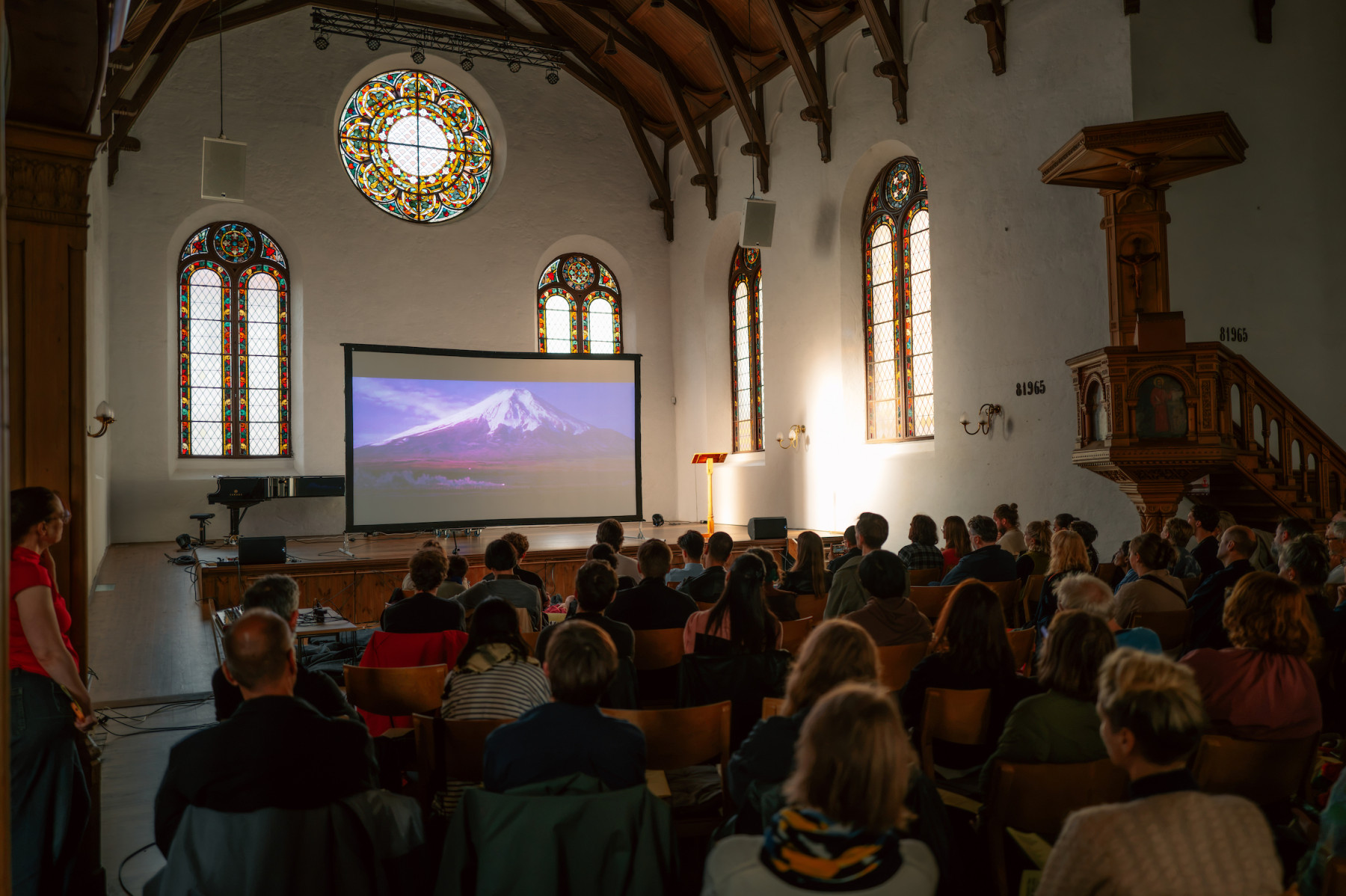
Chiemi Shimada's short film, photo credit : Stian Servoss
In the program sent by the lovely and iconic press officer, the weekend kicked off in the afternoon with a montage of archival clouds from Japanese film history by the artist Chiemi Shimada, followed by a listening exercise by Nolan Oswald Dennis, where the artist asked us to listen to the rumbles of the earth, detected by seismological stations in various locales. Noise as abstract information was made meaningful by the artist’s highly political narration of where and when these noises were detected. During the listening session, I thought of a haunting image I saw a few weeks ago, of the flash flood in the Tibet-Nepal border region. The flood so powerful that it swept off hundreds and thousand of lives in just a blink of the eye. Those haunting images feel so far away from where we are, in the warmth and safety of the Nordic region. This feeling and sensation came back to me often throughout the rest of my trip. The last program on the first day was an experimental electronic music set by the Bergen-based artist Simone Ghetti, whose black-and-white jagged visuals and sounds borderline on noise imply complexity that stems from an expertise in his respective field, but sitting there while the descending sun was shining through the stained glass window of Korskirken, the only thing I could think of was how beautiful the light outside must be.
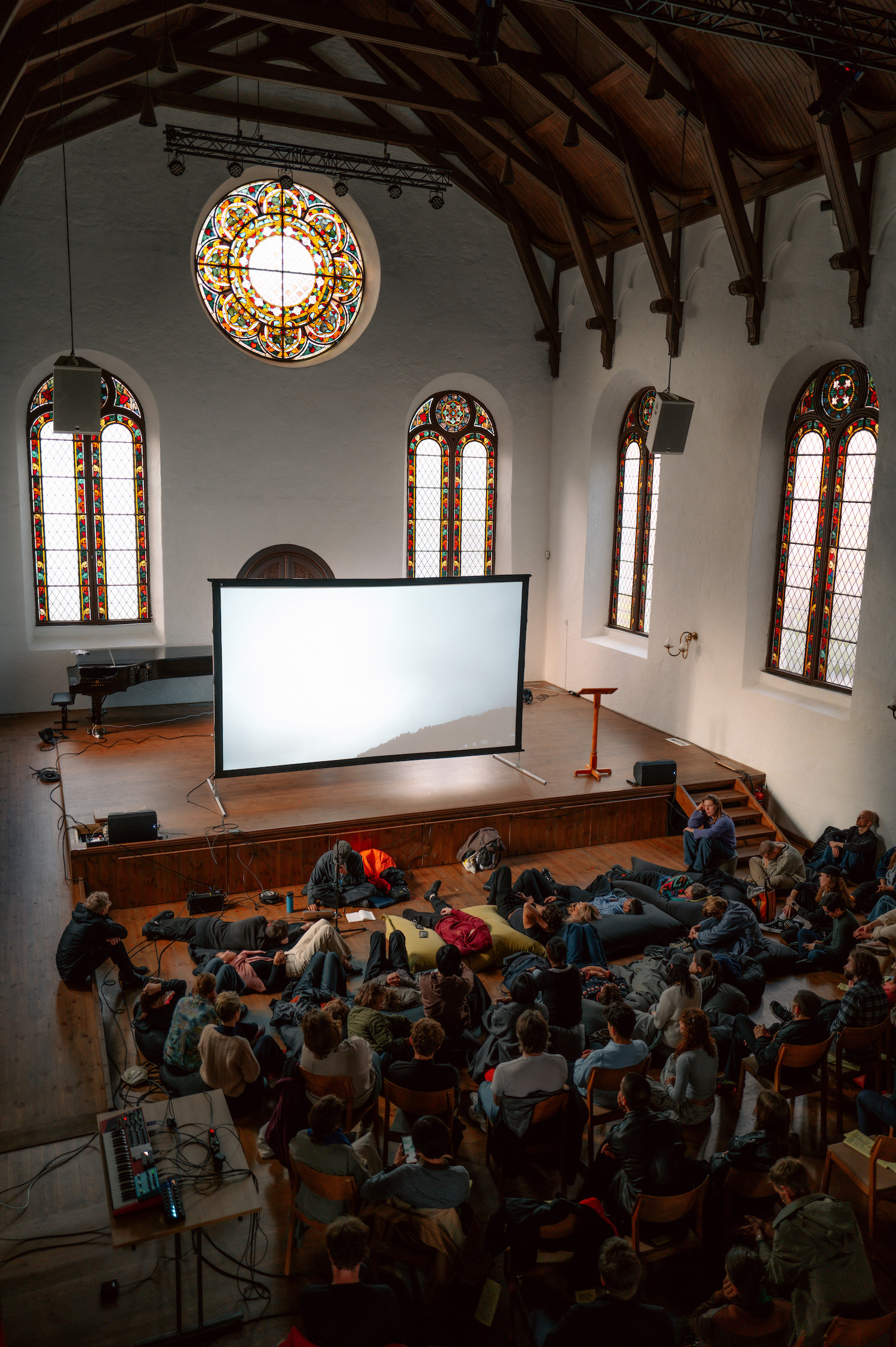
Nolan Oswald Dennis's listening session, photo credit : Stian Servoss
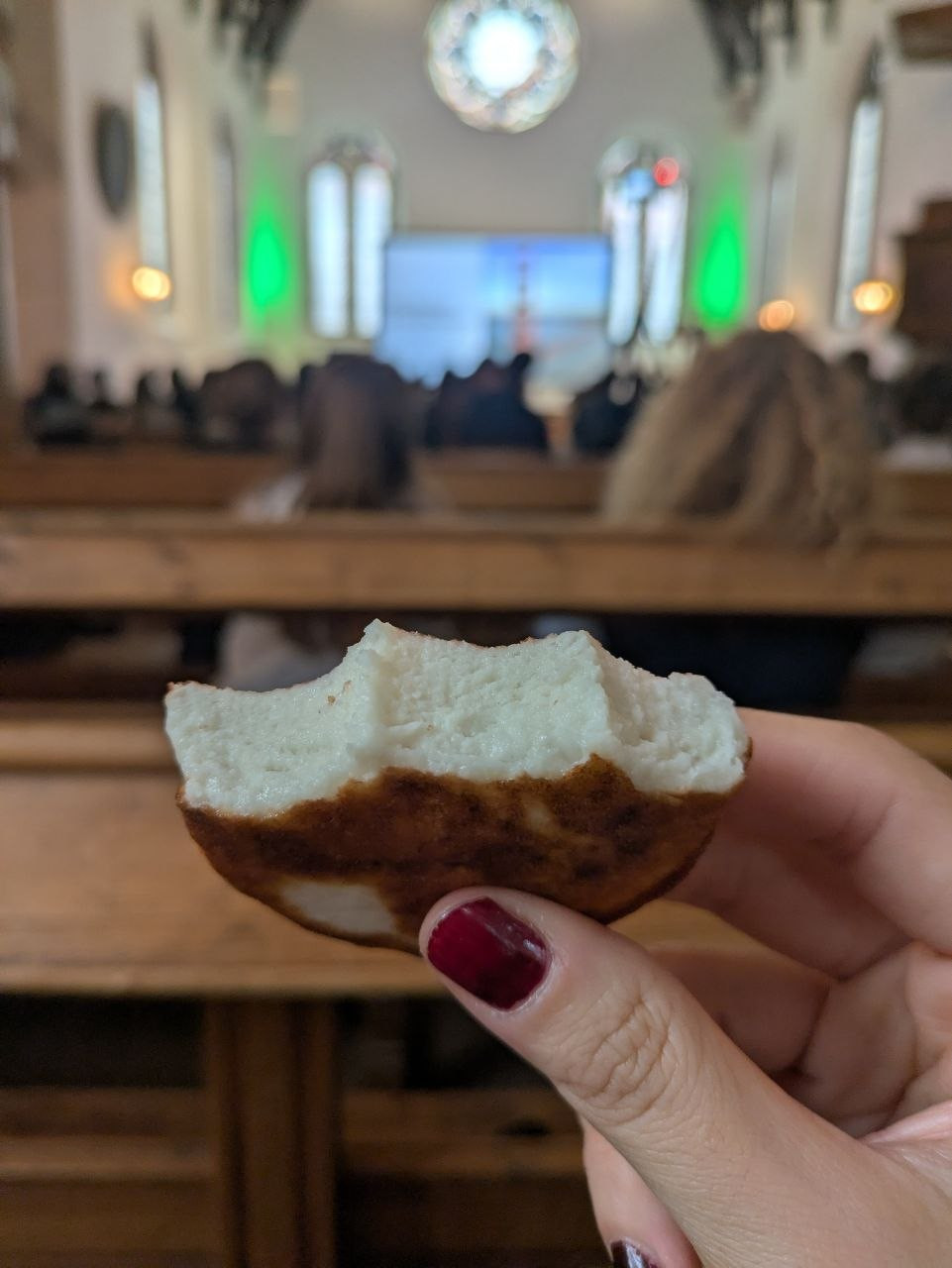
Norwegian fish frikadelle, photo credit : the author
The next day's program is a full day of presentations and lectures on various topics and interests that make my head spin with all the information and knowledge being transmitted in a short time span. Some are more approachable, like Simone Kotva’s generative reading of Giovanni Bellini’s painting Saint Francis in Ecstasy, her lecture combining knowledge in spiritual practice with ecological studies and plant studies, or James Bridle’s ad hoc way of dealing with the reality of the climate crisis on a Greek island, and Lua Vollard’s feminist history of the development of microchips.
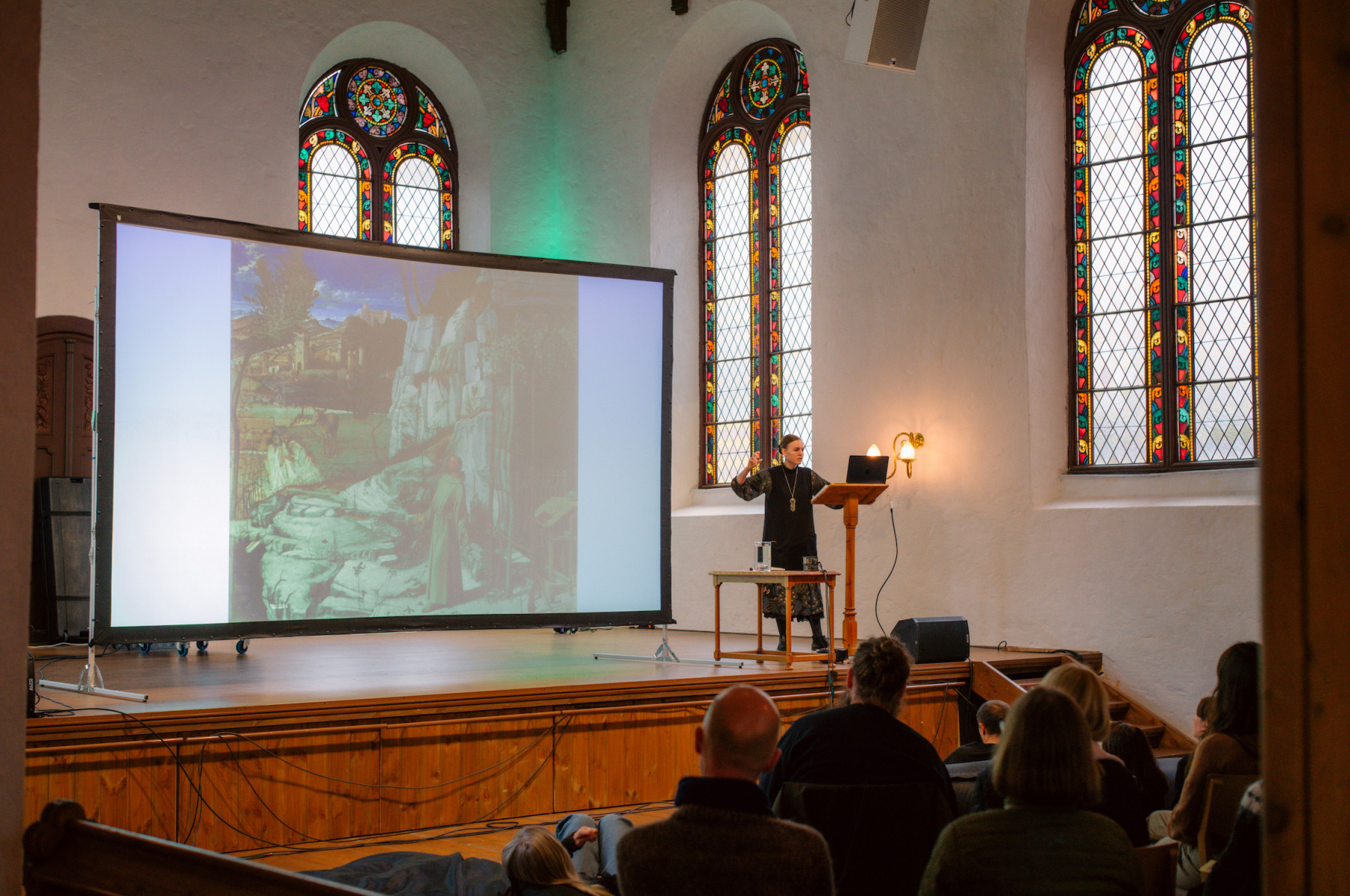
Simone Kotva's lecture, photo credit : Stian Servoss
Other lectures flew over my head in a way that reminds me of the time when I was a young student aspiring to become a curator, during a period of such positivity towards curatorial practice, with its grand, all-encompassing thematic exhibition, and its long and theoretically complicated curatorial text. Well, I am not sure if that is still the case today. My general feeling towards the program as a whole perhaps could be summed up by a short humorous encounter with Carolyn Christov-Bakargiev, a seasoned player in this field. After a long question from Ms.Pietroiusti that sounded more like someone is trying to process their thought out-loud; Ms. Christov-Bakargiev turned towards me with an air of joking impatience only perfected by these Art World’s grande dames “Do you understand what the question is about?” I shook my head shyly, trying to make sense of the density itself.
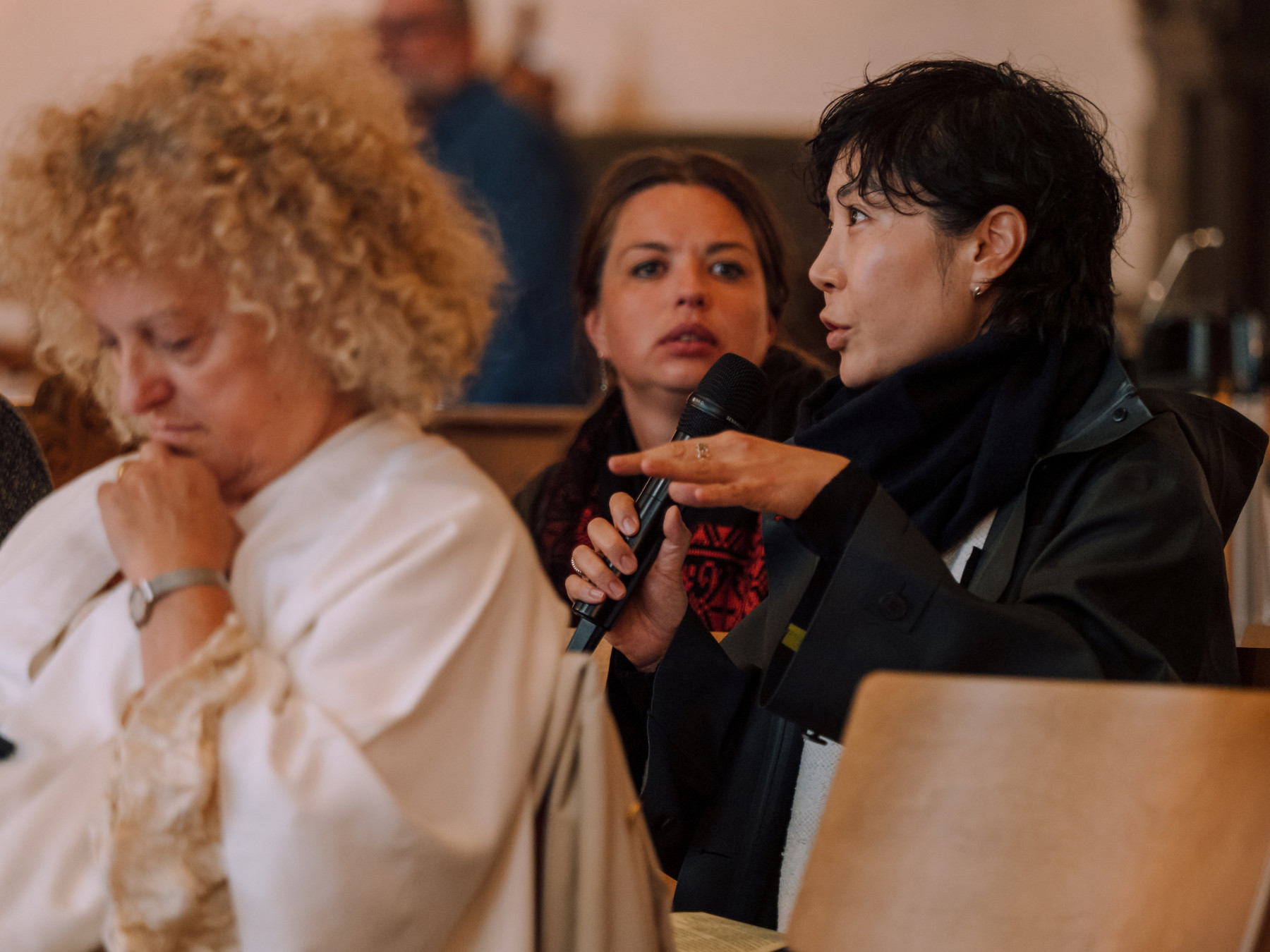
photo credit : Astrid Olsson

I love a good false friend, photo credit : the author
Since the program is so tightly packed, there is barely any time for open conversation & dialogue; often the conversation would be cut short by time constraints. Luckily, as part of the press corps, I get to exchange opinions and thoughts in a few private sessions with my colleagues. Some of us agreed that the program seems a little too Western-centric and cut off from the rest of the World, a fair point, since we’re in Norway, one of the wealthiest countries in the Western hemisphere. But beyond all this philosophising and talking of big words, and bigger topics, and of changes, technology, of world-making and ecstasy swirling around in the air. I suspect that the convenors might have a very big task ahead of them, if they were to be accountable for all the questions this Pandora’s box of an event has opened up. And I wonder further whether the event would have benefited from less crowded panels and more input from the city of Bergen and its population. That evening, as I sat there listening to the artist Marcus Coates making funny sounds in his deeply awkward performance “Conversation with the sky”, where the artist converses with an invisible cockney-accented “being” for 20 minutes just to reach a conclusion that we should be more thankful for what we’ve got. I think I have had enough of the complexity for the time being.
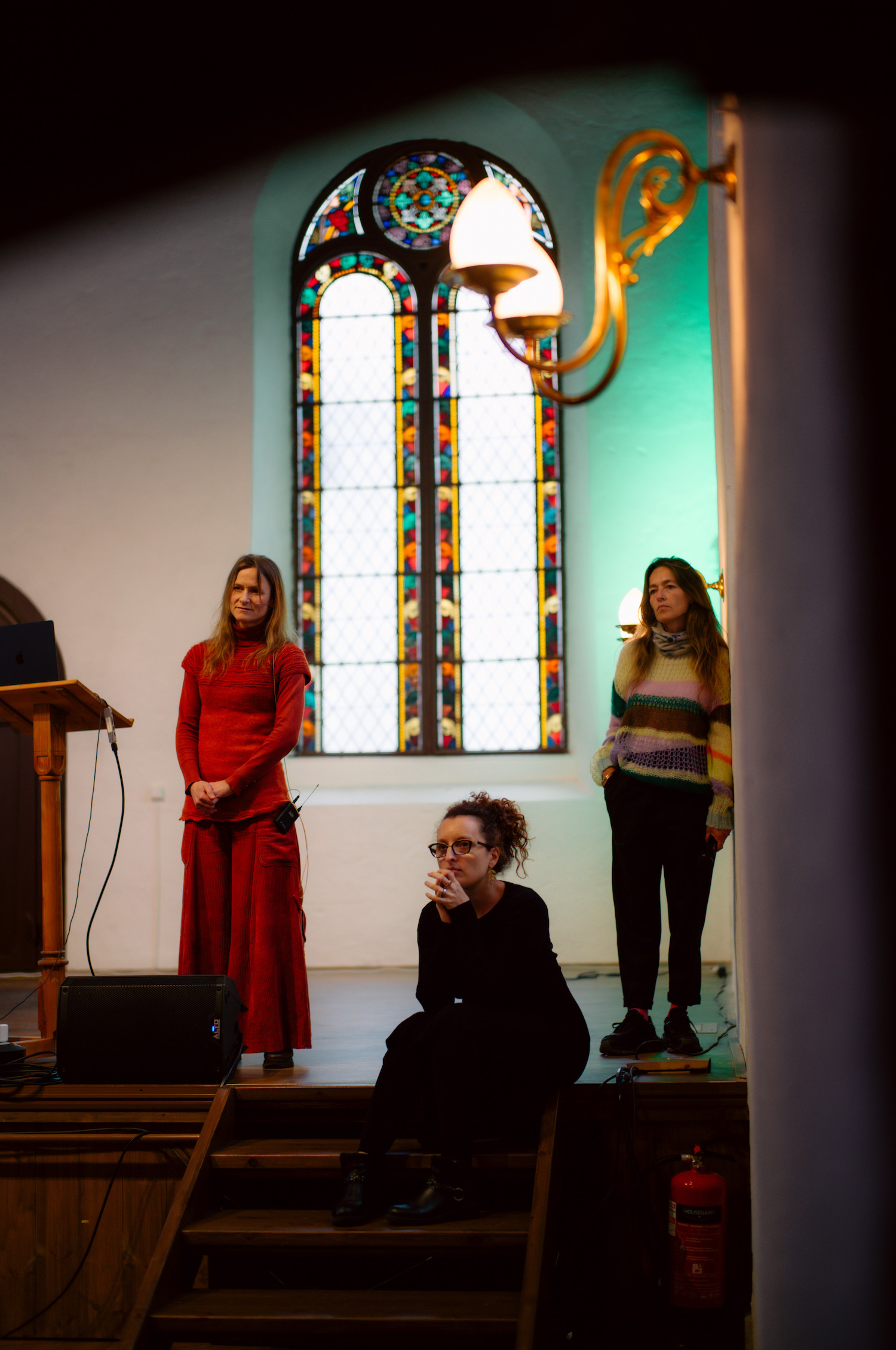
Ellen Viste, Bergen Assmbly 2028 convenors Lucia Pietroiusti and Filipa Ramos, photo credit : Stian Servoss
Early that morning, I went for a walk uphill to the northernmost part of Bergen city. Nothing was spectacular; the air was crisp and slightly damp. The sky and the sea seemed to be of the same shade of desaturated grey. I sat there at the waterfront for a while, taking in the view, when suddenly I was approached by two men asking whether I would have some time to check out a website. I thought to myself, oh God, not the Cryptobros; but then, when the older man told me the website’s name, something clicked: JW.org. Without letting him explain what it is, I instinctively answered that I am a Catholic and, to summarise the whole interaction, I didn’t let him go on, citing that I am having a moment in an abrupt and slightly rude tone. They stumbled off awkwardly, leaving me thinking to myself, Goddammit, it’s not even 10 am yet. I guess how proselytising for a pseudo-Christian cult has taken on the guise and language of cryptobros is also some form of complex technology.
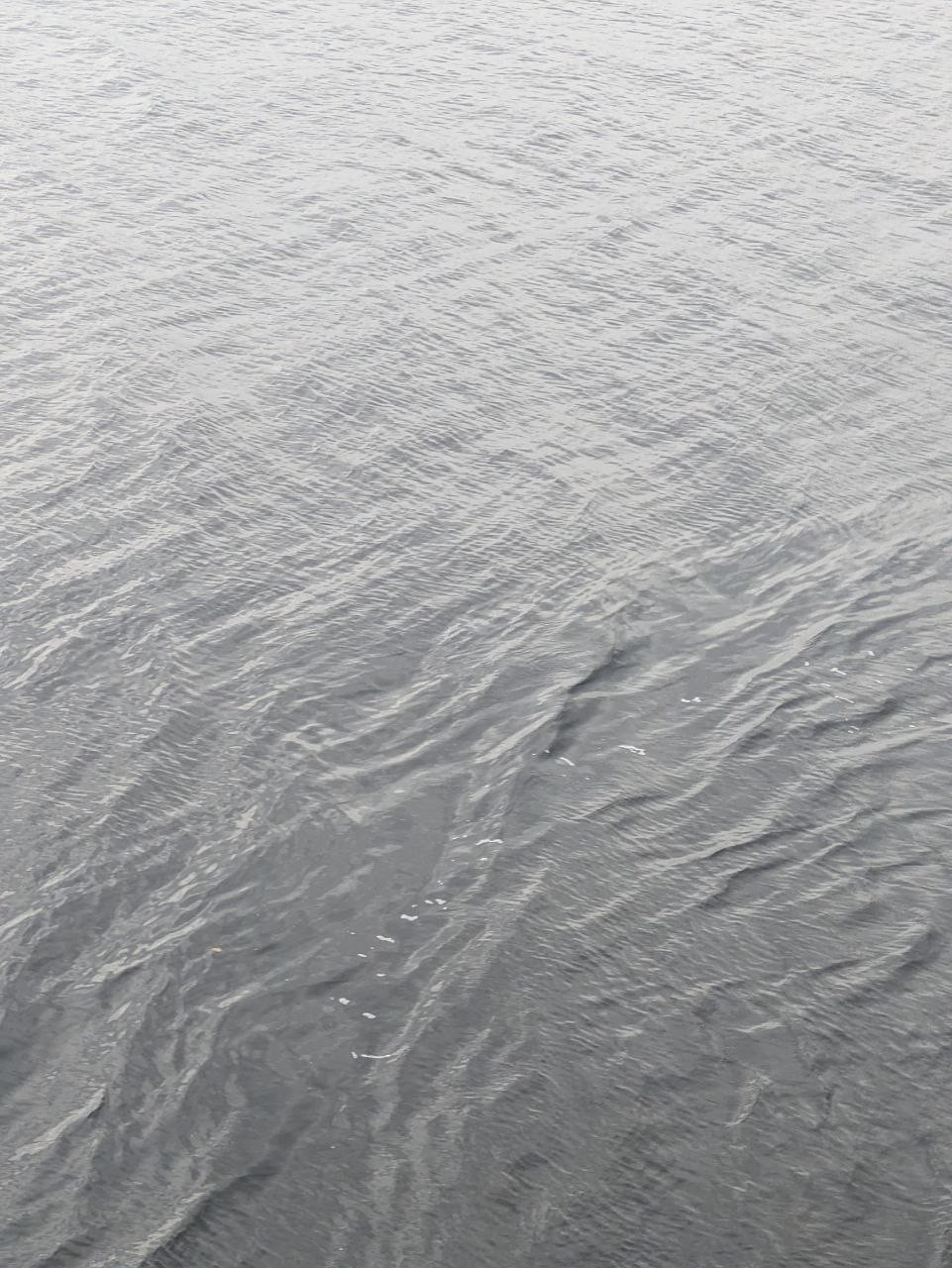
Grey morning water, photo credit : the author
This coverage is made possible with the support of the Norwegian embassy in Berlin.